
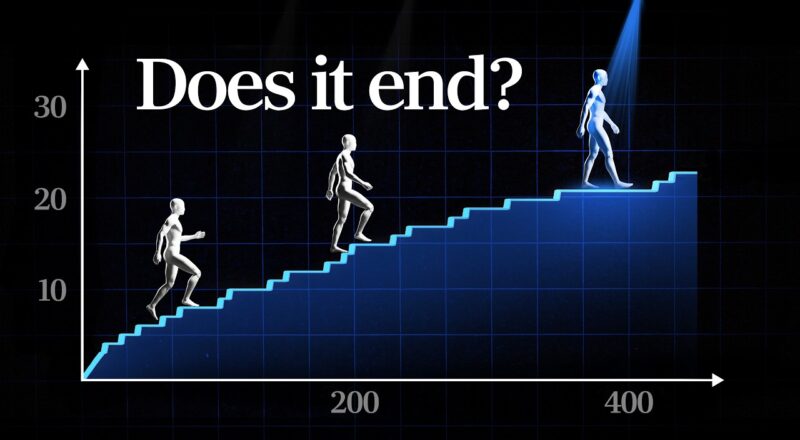
Mathematicians have long suspected twin primes — pairs of primes that differ by two — never run out. Heuristics and deep computations strongly support this, yet a rigorous proof remains elusive. The modern story of progress combines clever counting methods, sieves, and a series of breakthroughs that transformed an apparently impossible barrier into a flourishing line of research.
From heuristics to rigorous counting
Hardy and Littlewood used the prime number theorem to estimate how many twin primes should exist up to N, producing a prediction that matches numerical data extraordinarily well. But a heuristic is not a proof: subtle dependencies among primes and small rounding errors in combinatorial counts prevent turning that prediction into an airtight argument.
Brun’s sieve and the inclusion–exclusion problem
Viggo Brun adapted the ancient sieve of Eratosthenes to count twin primes. By counting numbers removed by small prime divisors and correcting overlaps with inclusion–exclusion, Brun controlled error terms by stopping the sieve early. The trade-off produced a landmark result: infinitely many pairs of numbers two apart where each number has only a bounded number of prime factors. Improvements culminated in Chen’s theorem: infinitely many primes p for which p+2 has at most two prime factors.
Average methods and the GPY idea
Goldston, Pintz, and Yıldırım (GPY) introduced an “averaging” stencil: slide a fixed admissible pattern along the integers and average how many primes the pattern captures. If the weighted average exceeds one, some translate must capture at least two primes, giving a bounded prime gap. Their method hit a technical ceiling tied to how well primes are distributed in arithmetic progressions (the so‑called level of distribution).
Zhang, Maynard and the bounded gaps breakthrough
Yitang Zhang found a way to reorganize GPY error terms by restricting attention to moduli composed of small primes, nudging past the level‑of‑distribution barrier and proving there are infinitely many prime gaps bounded by 70 million. That single advance transformed the field: collaborative refinement (Polymath) and independent innovations by James Maynard dramatically reduced the bound. Maynard’s approach bypassed the previous barrier entirely and showed one can force multiple primes inside a bounded window; as of now unconditional results give infinitely many prime pairs with gap at most 246.
What remains and conditional improvements
Further reductions depend on unproven distribution conjectures (e.g., Elliott–Halberstam). Under such hypotheses the gap can be pushed much lower — down to 12, then 6 — but without extra assumptions the unconditional record is 246. The twin prime conjecture itself (gap 2 infinitely often) remains open.
The twin prime question has driven development of powerful new tools in analytic number theory. Although we still lack a proof, successive breakthroughs show that obstacles once thought insurmountable can be overcome, and they provide reasoned optimism that a final resolution may one day arrive.