
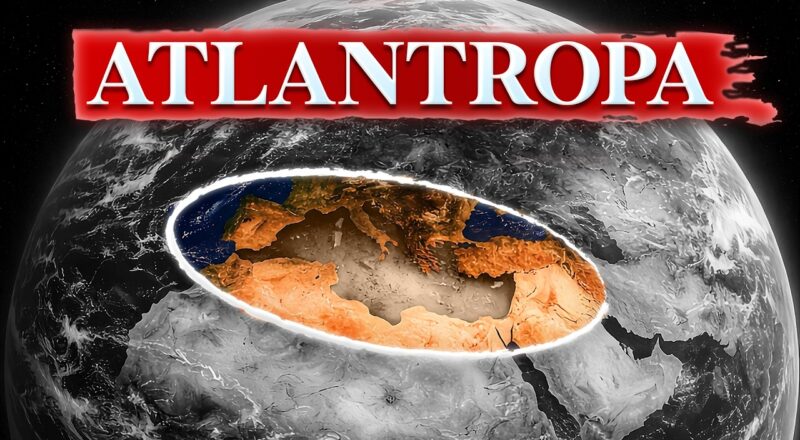
Imagine Europe and Africa fused into a single supercontinent, Venice stranded hundreds of kilometres inland and new plains rising where the Mediterranean once lay. In the late 1920s and 1930s a German architect proposed just that: drain the Mediterranean, create millions of hectares of new land and generate colossal hydroelectric power. The plan, called Atlantropa, combined technocratic optimism, colonial assumptions and grand engineering — and it nearly captured European imaginations.
Origins: crisis, population and a technocratic dream
Europe in 1929 was reeling from the Depression, demoralised by the First World War and anxious about population pressure and economic collapse. For many intellectuals and planners the continent’s remedy lay in Africa — vast empty spaces and abundant resources to absorb surplus people. Against that backdrop Herman Sörgel, an architect trained in engineering, read hydrological studies showing the Mediterranean loses enormous volumes of water daily through evaporation and is replenished almost entirely through the Strait of Gibraltar. He saw an opportunity to reproduce the geologic drying event of five million years ago, not by tectonics but by human engineering.
The scheme: dams, power and reclaimed land
Sörgel proposed an audacious network of dams and hydraulic works to cut off the Atlantic inflow, lower sea levels and expose a continental land bridge between Europe and Africa. The central element was a Gibraltar dam — roughly 35 km long and 300 m high in his design — intended to stop the Atlantic “tap.” Additional barriers would sever the Mediterranean into basins, lower each basin by scores or hundreds of metres and protect inflows from the Black Sea. As the sea fell, new coasts and plains would emerge, connecting Corsica with Sardinia, enlarging Sicily, and pushing Venice far inland.
Purported benefits: energy, food and geopolitics
Sörgel did not sell the project as mere land reclamation. The Gibraltar dam would be a gargantuan hydroelectric plant, producing tens of thousands of megawatts — he estimated capacity comparable to dozens of nuclear reactors. High-voltage transmission lines would knit Europe and North Africa into an energy interdependence designed to deter war: cut electricity and a belligerent state would suffer crippling consequences. Reclaimed land could be irrigated from river diversions to create agriculture and settlement for millions of Europeans. Politically, Atlantropa was pitched as a third global bloc — Europe‑Africa united against American and Asian power.
Practical and moral failures
Despite its appeal to some architects and committees, Atlantropa was riddled with fatal flaws.
- Timescale: lowering the Mediterranean to Sörgel’s targets would take centuries, leaving ports and coastal economies in limbo and disrupting maritime trade for generations.
- Cost and materials: estimates then and later implied resources and concrete requirements exceeding feasible production for many decades, plus an unprecedented level of international cooperation during a period of extreme geopolitical friction.
- Poor soils: the newly exposed seabed would be salt-laden and infertile; centuries of desalinisation and soil remediation would be required before reliable agriculture was possible.
- Climatic risk: altering such a large water body could disrupt regional and perhaps global climate systems — for instance, weakening currents that moderate Europe’s climate and threaten agricultural productivity.
- Colonial ethics: the plan assumed Africa as a hinterland for European settlement, ignoring indigenous rights and self-determination.
Political fate and legacy
Atlantropa gained notable support in the interwar years, with conferences and committees across Europe. The idea lost momentum when Nazi Germany rejected it (Hitler’s expansionist focus was eastward and incompatible with Atlantropa’s pacifying interdependence), and the Second World War shifted priorities. After the war Sörgel kept promoting the idea but died in 1952; the institute behind Atlantropa survived into the 1960s. Postwar reconstruction, nuclear power and decolonisation removed both the political rationale and the practical base for the plan. Instead of a single engineering megaproject, European integration followed institutional paths such as the ECSC and the Treaty of Rome.
Atlantropa stands today as an extreme early example of geo‑engineering hubris: a technically imaginative proposal driven by a mix of utopian pacifism and colonialist assumptions, promising sweeping benefits while sidelining ecological risk and human rights. It’s a cautionary tale: ambitious proposals that aim to “fix” complex social and environmental problems through single large-scale interventions can create problems far worse than the ones they promise to solve.