
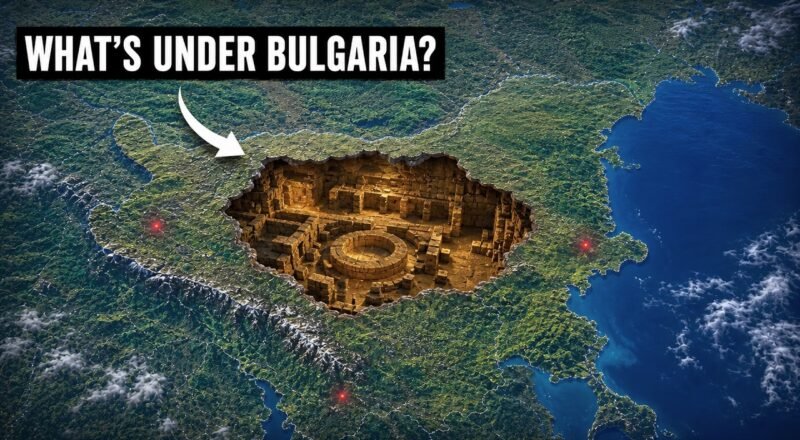
Bulgaria is a surprising archive of humanity’s earliest mysteries: petrified forests, rivers that vanish into the underworld, medieval rock carvings, and some of the oldest and richest human remains and treasures ever found. These sites don’t just fascinate — they rewrite parts of Europe’s deep past and leave more questions than answers.
Pobiti Kamani — the forest of stone
West of Varna a sandy plain is dotted with hundreds of free‑standing stone columns up to 10 m tall. Known as Pobiti Kamani, the “stones beaten into the ground,” these hollow, sand‑filled pillars have no clear foundation. Proposed explanations range from petrified trees and coral to a microbial cementing process around methane seeps 50 million years ago. None fits every detail, and locals prefer a mythic answer: giants hammering rocks into the earth.
The river that swallows things — Devil’s Throat
In the Trigrad Gorge a river plunges 42 m into a cave chamber called the Hall of Thunder and then reappears a short distance away — yet dye tracing shows the water takes over an hour to travel that gap. Objects sent into the cave often vanish. Divers who explored the flooded passages in 1970 never returned. Ancient Thracian myth even named this cave an entrance to the underworld.
Varna Necropolis and the first European town
Near the Black Sea, excavations at Varna revealed thousands of gold objects from burials dated c. 4600–4200 BCE — the oldest large gold treasury known. A single grave contained more gold than whole regions held at that time, implying extreme social inequality centuries before states. Inland, the saltworks settlement at Solnitsata (near Provadia) produced salted bricks and monumental walls around 4700–4200 BCE; its control of salt trade explains how distant wealth, including gold, may have flowed into the region.
First Europeans — Bacho Kiro Cave
Skeletal fragments from Bacho Kiro Cave date to roughly 46,000–42,500 years ago and belong to early modern humans in Europe. Their DNA shows recent Neanderthal ancestry — a rare close snapshot of interbreeding — yet surprisingly this group left little genetic legacy in later Europeans; their lineage survives mainly in populations of East Asia and the Americas.
Other notable mysteries
- Medieval cliff reliefs of horsemen whose authorship and symbolism remain debated.
- Medieval burials with iron stakes driven through the chest to prevent the dead rising as “vampires.”
- Living rituals such as the fire‑walking nestinari, blending Orthodox and older pagan practices.
- Repeated accidental treasure discoveries — Panagyurishte, Rogozen, and others — that suggest far more remains buried.
Across landscapes and millennia, Bulgaria repeatedly appears at the frontiers of human change: innovation, ritual, wealth, migration and disappearance. Each discovery illuminates an early chapter of European history — and too often leaves the final sentence unwritten.