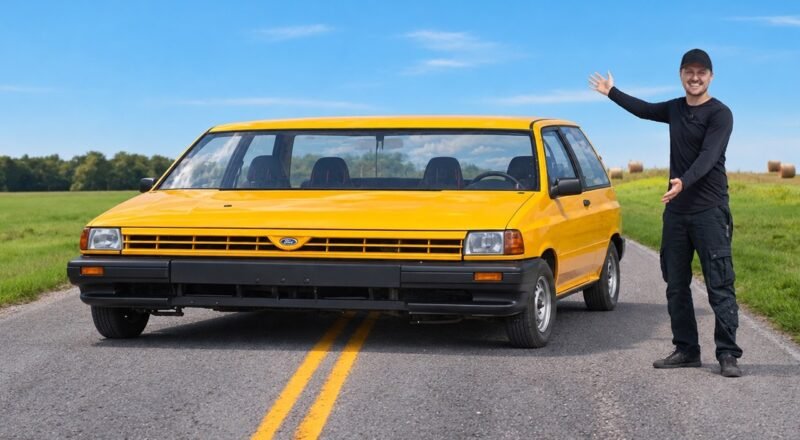
I built a 10-foot-wide, street-legal car by radically modifying a compact hatchback. The project involved cutting donor cars in half, fabricating a new center section, reworking driveline and suspension components, and finishing extensive body and interior work so the result would both function and pass inspection with the proper permits.
Choosing the target width and legal considerations
The team settled on a 10 ft overall width — wider than the typical 8 ft 6 in limit for normal road vehicles, but still manageable with special wide-load permits and commercial insurance. Going wider would have required escort vehicles and pre‑approved routes, so 10 ft was a practical compromise between drama and usability.
Cutting, stretching, and structure
Using multiple Ford Festiva donor cars, the build began by slicing bodies down the center and spreading the halves apart. Critical steps included removing adhesives from the floor, precise laser-guided cutting, and adding a heavy central structural section. The team used 10‑gauge steel for the floor and 18‑gauge for the roof, and paid attention to butt joints and weld seam placement to preserve rigidity.
Drivetrain, suspension, and the custom CV axle
Because the original layout was front‑wheel drive, the rear axle was relatively simple to extend. The front required more care but retained original mounting locations. One of the biggest engineering challenges was fabricating an approximately 5 ft extension for a CV axle. The shaft was jig‑mounted, welded, and carefully cooled and corrected for straightness to minimize vibration at speed.
Bodywork, details, and 3D printing
Laser welding filled gaps in the stretched body, followed by lots of filler, sanding, primer, and paint. Large ABS interior pieces—including an oversized dash and an 8‑ft grille—were 3D printed and joined with solvent welding. Small design choices (louvers, matching holes, and polished details) helped make the wide vehicle look intentional rather than cobbled together.
Road testing and finish work
- Final systems: auxiliary power unit, generator, AC, lighting, and a custom gas tank arrangement.
- Adjustments: tie‑in plates, hood latch reinforcement, lift kit in the front to level the stance, and tire pressure tuning.
- Compliance: commercial insurance, wide‑load permit, and DMV inspection to obtain a special plate.
After fabrication and paint, the car completed long drives, parking maneuvers, and law‑enforcement stops. Practical issues like turning, lane maintenance, and passenger operation were addressed by retaining usable controls for both sides and ensuring the vehicle met permit requirements.
This build demonstrates how measured design choices, careful fabrication, and attention to legal requirements can turn an extreme concept into a functional, street‑legal vehicle. The finished car is both a technical challenge solved and a playful, usable machine for road use with the right permits.