
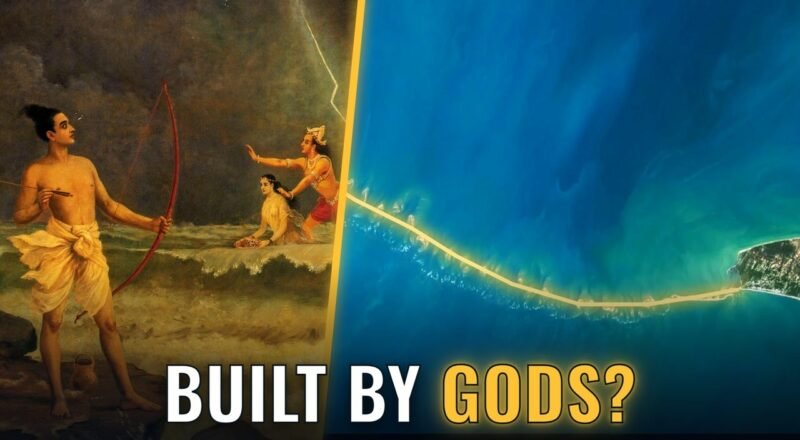
From space the chain of shoals between India and Sri Lanka looks almost deliberately placed — a thin, broken line of sand and rock spanning roughly 30 kilometres. For millennia people have woven myths around that line: stories of gods, armies, and a miraculous bridge that carried them across the sea. Modern science has now mapped the formation in unprecedented detail, but the debate between legend and geology continues.
The myths: Rama Setu and Adam’s Bridge
Two long-standing traditions give the shoals different meanings. In the Hindu epic the Ramayana, Prince Rama’s army of vanaras builds a bridge to reach Lanka; stones inscribed with Rama’s name reportedly floated, allowing the army to cross. Islamic and medieval accounts gave the feature the alternative name Adam’s Bridge, tying it to another origin story in which Adam crossed from Sri Lanka after leaving paradise. Both names and narratives have been part of local memory for centuries.
Scientific mapping and what it shows
Orbital photographs once fuelled claims that the formation must be man-made, but images alone cannot determine age or origin. In 2024, India’s space agency used five years of laser-altimetry data to produce a high-resolution underwater map. The result: a continuous submerged ridge about 29 km long, rising roughly 8 m from the seafloor and cut by several narrow channels. Crucially, the study described the structure as a natural extension of the nearby land, shaped by sand movement and ancient reefs.
How nature can build a “bridge”
Geologists point to changes since the last ice age. When sea levels were much lower, India and Sri Lanka formed a single landmass. As seas rose, currents concentrated sand along a higher zone between two bays, allowing corals to grow and reef rock to form. The result is a tombolo — a natural sand-and-reef connection that looks engineered but is the product of thousands of years of coastal processes.
Floating stones and cultural impact
The legendary “floating stones” have plausible natural explanations: pumice and porous reef rock can be buoyant. Such stones, washed ashore, could have inspired stories of miraculous materials. The formation has also influenced modern decisions: a proposed shipping canal through the shoals was halted after protests and legal challenges, reflecting the feature’s cultural as well as physical importance.
In short, satellites and seabed mapping show a striking, almost bridge-like ridge shaped by sea, sand and reef growth over millennia. No peer‑reviewed study has demonstrated human construction, but the formation’s place in human imagination is undeniable — a natural feature that carried a story across generations.