
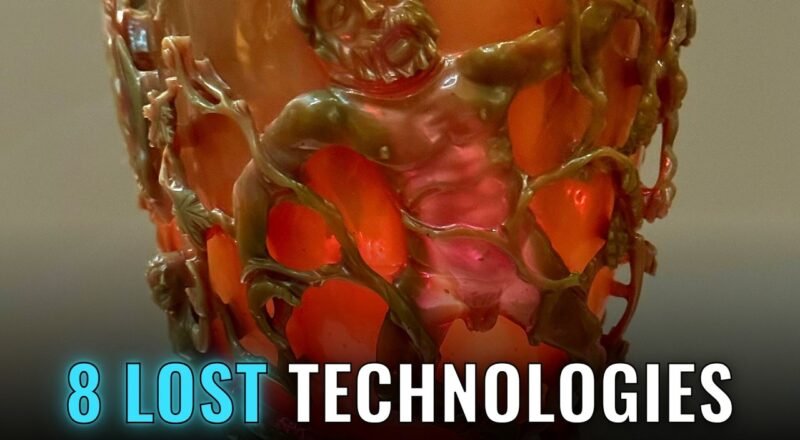
Ancient technologies often look like magic to modern eyes: materials that resist corrosion, buildings that repair themselves, and weapons that defied the limits of their time. Archaeology and materials science have recovered explanations for many of these feats — sometimes centuries later — while a few remain mysteries. Here are eight striking examples of lost ancient technologies, from the well-understood to the still-unexplained.
A pillar that refuses to rust
In Delhi stands a more-than-7‑meter iron column made during India’s Gupta period (around year 400) that has survived 1,600 years of monsoons with almost no corrosion. Metallurgists found the metal unusually high in phosphorus, which over time forms a thin, protective film (a compound sometimes called misawite). The result is a naturally passivating iron that ancient smiths produced by a method later forgotten.
Concrete that heals itself
Roman concrete has outlived modern mixes by centuries — notably the Pantheon’s unreinforced dome and Roman harbor piers that strengthened in seawater. Volcanic ash and lime produce chemical reactions that form new minerals in cracks. Recent work suggests the Romans deliberately used “hot mixing” with quicklime, leaving small lime lumps that later dissolve and reseal fissures, creating a slow self-healing concrete.
Glass, metal, and nanoscale effects
Some Roman glass cups change color dramatically depending on lighting. Electron microscopy revealed gold and silver nanoparticles embedded in the glass; at that scale the particles alter light scattering and produce striking color effects. Ancient artisans were effectively exploiting nanoscale optics long before the concept existed.
Weapons, machines, and vanished savoir-faire
Damascus steel blades, famed for sharpness and flowing patterns, were tied to specific ores (with trace elements) and smithing routes that disappeared by the 18th century; modern reconstructions have partially reproduced them and even found carbon nanotube-like features. The Antikythera mechanism — a hand‑cranked Greek astronomical computer from ~2,000 years ago — demonstrates sophisticated gearing unmatched for a millennium, yet no obvious tradition of similar devices survives. And a Han‑dynasty seismoscope reportedly indicated distant earthquakes by dropping a ball into a toad’s mouth; descriptions survive but the internal mechanism is lost.
Extinct resources and the enduring mystery of Greek fire
Some prized ancient resources vanished through overharvest: sulfium, a highly valued Roman plant from Libya, became effectively extinct and its exact identity remains debated. And then there is Greek fire — a Byzantine naval incendiary that burned on water and decisively defended Constantinople. Contemporary accounts describe a pressurized liquid sprayed from bronze siphons, but the precise recipe and mechanism were guarded and ultimately lost; modern reconstructions use plausible ingredients like crude oil, resin, and quicklime, but no definitive replication has been proven.
These examples show that ancient societies achieved complex, sometimes surprising technological solutions. In some cases modern science has caught up and explained the methods; in others key details were never passed on, leaving tantalizing puzzles about how our predecessors turned experimentation into durable technology.


