
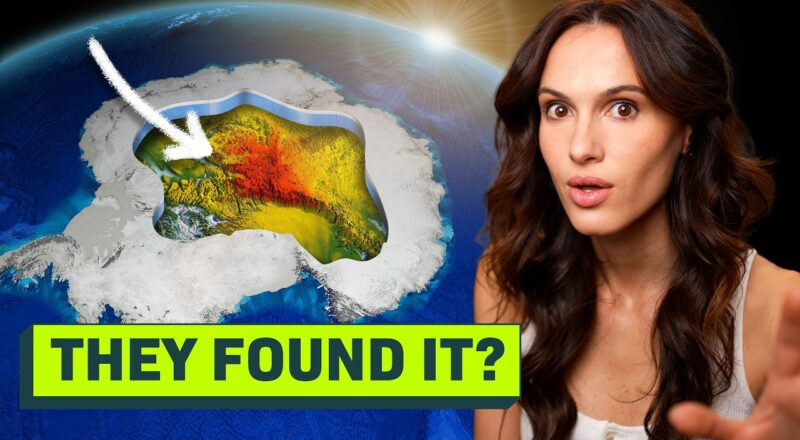
When you look at Antarctica from above, it seems like a blank, endless white expanse — no birds, no trees, nothing but ice. But beneath that silence there’s a surprising and dynamic world: ancient mountains, giant trenches, rivers and, most astonishingly, entire lakes of liquid water sealed under kilometers of ice. Over decades of exploration, scientists have gone from guessing what lies below to actually breaking into these hidden lakes and finding life that’s been isolated for millions of years.
How do you even get under the ice?
Drilling through Antarctic ice is not like digging a garden hole. The ice sheet is miles thick in places — at its tallest it rivals Mount Kilimanjaro — and it’s not a single uniform slab. The top layers are wind-packed snow that barely accumulates each year because Antarctica is technically a desert. Deeper down that snow compresses into firn, a sponge-like stage between snow and true glacial ice, and below that the ice becomes denser and bubble-free.
Mapping the hidden landscape
Before anyone attempts to drill, researchers use clever remote sensing. Early teams set off controlled explosions and measured seismic waves; today we have satellites and ice-penetrating radar flown from planes to map the contours beneath the ice. Those surveys revealed a surprising topography: canyons deeper than the Grand Canyon, a mountain range rivaling the Alps, and vast volcanic regions. They also hinted at flat depressions — the telltale signs of subglacial lakes.
Lake Vostok and the moment of discovery
One of the most famous discoveries began with Soviet drilling that continued for nearly three decades. Around 3,500 meters down, the drillers hit clear, bubble-free ice and finally encountered liquid water — a massive lake later named Lake Vostok, roughly the size of Lake Ontario and one of the largest lakes on Earth by volume. The existence of liquid water under so much ice makes sense: the ice acts as an insulator, geothermal heat from the Earth’s interior warms the base, and immense pressure lowers the freezing point of water.
Cleaning the drill and finding life
Breaking into a lake that has been sealed from the surface for millions of years raised huge concerns about contamination. Some early Russian work used kerosene-based drilling fluids and produced controversial biological results that were hard to interpret. Later expeditions developed cleaner methods, using filtered, UV-treated hot water to melt through the ice without introducing foreign microbes. When British and American teams finally reached other subglacial lakes, they brought up water and sediment samples that contained thriving microbial ecosystems — bacteria, bacteriophages (viruses that infect bacteria), and other life adapted to dark, high-pressure, low-energy conditions.
A plumbing system under the ice
Lake Vostok isn’t unique. Satellite observations have shown hundreds of subglacial lakes across Antarctica, and some are “active” — filling and draining and even lifting parts of the ice sheet by meters. Those lakes are connected by an underground network of rivers and channels, a hidden plumbing system that affects how ice flows and how the continent responds to climate change.
Why it matters — for Earth and beyond
Finding life in these extreme, isolated places tells us something powerful about biology’s resilience and adaptability. It also gives us a testbed for thinking about life on icy worlds like Jupiter’s moon Europa or Saturn’s Enceladus. The same drilling, sampling and contamination-control techniques developed in Antarctica are the models for how we might search for extraterrestrial life beneath alien ice.
There’s still so much to explore: hundreds of lakes remain untouched, and every clean sample has the potential to teach us about ancient ecosystems, Earth’s climate history, and the boundaries of life itself. I came away amazed — not just by the alien feeling of that frozen continent, but by how human curiosity, care and teamwork have peeled back the ice to reveal a surprisingly lively world beneath.


