
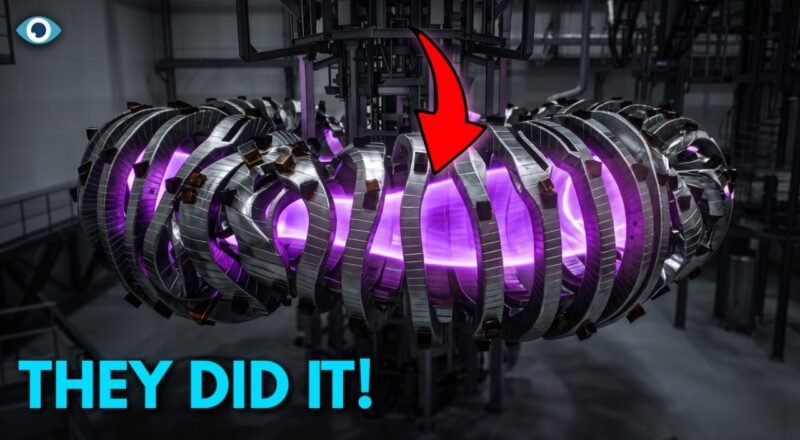
In 2023 a group of researchers in Munich launched Proxima Fusion with an ambitious aim: turn the stellarator — a once-neglected fusion design — into a commercial power plant. Backed by major investment and a high valuation, the company’s fate now hinges on a single, unprecedented magnet due in 2027.
Why fusion, and why the stellarator?
Fusion recreates the process that powers the sun: hydrogen nuclei merge to form helium and release enormous energy. On Earth this requires heating fuel to temperatures exceeding 100 million °C and holding it away from any material surface using magnetic fields. Unlike a fission reactor, fusion has no runaway chain reaction, and its fuel can be sourced from seawater and lithium.
Tokamaks versus stellarators
Two magnetic confinement approaches dominate. The tokamak — a donut-shaped device — drives a large current through the plasma and has produced many headline results, but that current can abruptly collapse and damage the machine. The stellarator performs all the twisting with external magnets, allowing steady, continuous operation, but its complex, twisted coils are very challenging to design and fabricate.
Wendelstein 7-X and the path to a power plant
Germany kept developing stellarator technology at the Max Planck Institute, culminating in Wendelstein 7‑X. After years of complex coil construction and cost overruns, Wendelstein demonstrated long, high-performance plasma pulses, proving the concept. That success inspired a team from Max Planck, MIT and Google X to publish a full plant design called Stellaris in 2025 and to found Proxima Fusion.
Magnet technology and the €2.4 billion valuation
Proxima’s design uses high-temperature superconducting tapes to generate much stronger magnetic fields than older materials, enabling a smaller, cheaper plant. The critical near-term milestone is the Stellarator model coil, a demonstration magnet due in 2027: if it produces the required field strength, the concept is viable. Investment accelerated after agreements with Bavarian authorities, Max Planck and utility RWE, and a €411 million funding round in 2026 that included Google and RWE and valued Proxima at about €2.4 billion.
Where Europe stands in the global race
Internationally, competitors are progressing on different tracks. U.S. tokamak startups have raised large sums and aim for near-term milestones, while China has invested heavily in large tokamaks. Proxima’s advantage would be a machine that can operate continuously and integrate with renewables as steady baseload, but its demonstration device (Alpha) is not expected to operate until the early 2030s.
Risks and realistic expectations
Fusion timelines frequently slip, and technical or political setbacks could delay or derail Proxima’s pathway. A significant portion of Alpha’s funding depends on public support, and the demonstration magnet remains the decisive technical risk. If it succeeds, Europe could host the first stellarator power plant; if it fails, critics will point to the difficulty of translating lab success into commercial electricity.
Proxima Fusion represents Europe’s most concentrated push to turn stellarator physics into usable power: proven plasma performance, major public and private funding, and a high-stakes magnet test ahead. The next few years will show whether that €2.4 billion bet pays off or becomes another lesson in the challenge of taming the stars.


