Europe’s newest mega-canal is more than a waterway: it’s a strategic trade corridor designed to link northern France with Belgium, the Netherlands and the wider North Sea network. At 107 km long and 54 m wide, the Seine-Nord Europe canal is being built to accommodate much larger inland vessels, speed up freight movements, and strengthen connections into the EU’s trans‑European transport network.
Why build a new canal?
France already has the largest national navigable network in Europe, but many historic routes are too small for modern barges. The existing Canal du Nord proved slow to adapt: narrow locks and limited capacity meant it could not serve today’s larger vessels. The new canal is intended to replace and supersede that route, allowing ships up to around 4,500 tonnes and reducing pressure on road and rail corridors.
Scale, cost and funding
The project is estimated at roughly €7.3 billion. About half of the cost is provided by the EU, with the remainder shared between the French state and regional and departmental authorities along the route. Construction formally progressed after years of planning, with a managing company (Société du Canal Seine‑Nord Europe) established to coordinate delivery.
Engineering highlights
- Seven major locks, including two with drops over 25 m, will be the deepest in Europe and engineered for fast lockage (target under 15 minutes).
- Extensive digital and physical modelling is used to optimise components such as perforated floor slabs and dissipation chambers, reducing risk before full‑scale construction.
- Sixty‑two road and rail crossings are integrated into the design; many bridges and prefabricated decks are already installed using clever launching and barge delivery techniques.
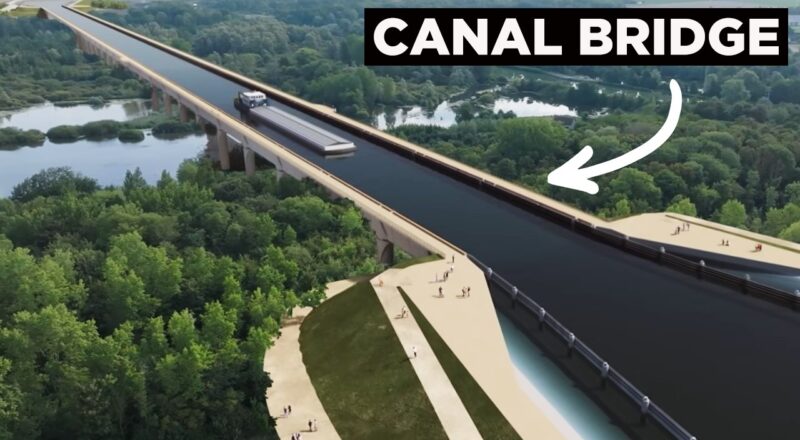
- A 1.3 km viaduct will carry the canal over the existing valley infrastructure, becoming Europe’s longest canal viaduct.
Construction methods and sustainability
Construction uses existing waterways to move materials where possible, minimising road haulage and carbon emissions via ten designated construction quays. Water‑saving systems for the locks include cascaded basins, culverts and pumps to recycle water efficiently and lower environmental impact.
Heritage and biodiversity measures
The route crosses territory with deep historical significance, including First World War battlefields. The project team has carried out extensive archaeological surveys in collaboration with heritage organisations to recover and re‑bury remains respectfully. To offset ecological impact, 1,200 hectares are being dedicated to biodiversity improvements, with wetlands, wildlife crossings and new tree planting. Some species have already begun returning to restored habitats.
With a target opening around 2032, the Seine‑Nord Europe canal aims to reshape freight flows across north‑west Europe by enabling larger, more efficient inland shipping and strengthening links between France and major northern ports. If delivered on time, it will be one of the largest inland navigation projects on the continent, combining ambitious engineering, digital project delivery and environmental mitigation.